
Just watched the North Dakota and Minnesota Duluth men’s hockey teams finish the third overtime of their NCAA regional final. Doubleheaders are not normally a hockey thing. Right now this is the second longest game in NCAA tourney history.
Whitmer claims that the current COVID-19 surge in Michigan is different because of the vaccines, and I find that hard to believe. I think citizens have demonstrated an unwillingness to do the right thing and the corresponding loss of life is of little concern.
Weeks ago Michigan began “opening” up again by allowing more people in restaurants and bars and more sporting events. Predictably, the number of new COVID-19 cases has been trending back up. I wish people would look at the graphs, it shows the numbers keep going up when we open up and down when we close down.
Unfortunately, I strongly suspect the governor is less likely to impose another lock down due to the amount of pressure put on by the people who continually cause the increase in numbers.
Last year on this date, Reuters wrote:
The United States has the potential to become the new epicenter of the coronavirus pandemic due to a “very large acceleration” in infections there, the World Health Organization said on Tuesday.
Unfortunately, that proved true.
The NFL appears to be expanding the number of streaming options for games, but I don’t see info about an ability to stream out of market games. The NFL needs a reasonably priced equivalent to MLB’s At Bat app.
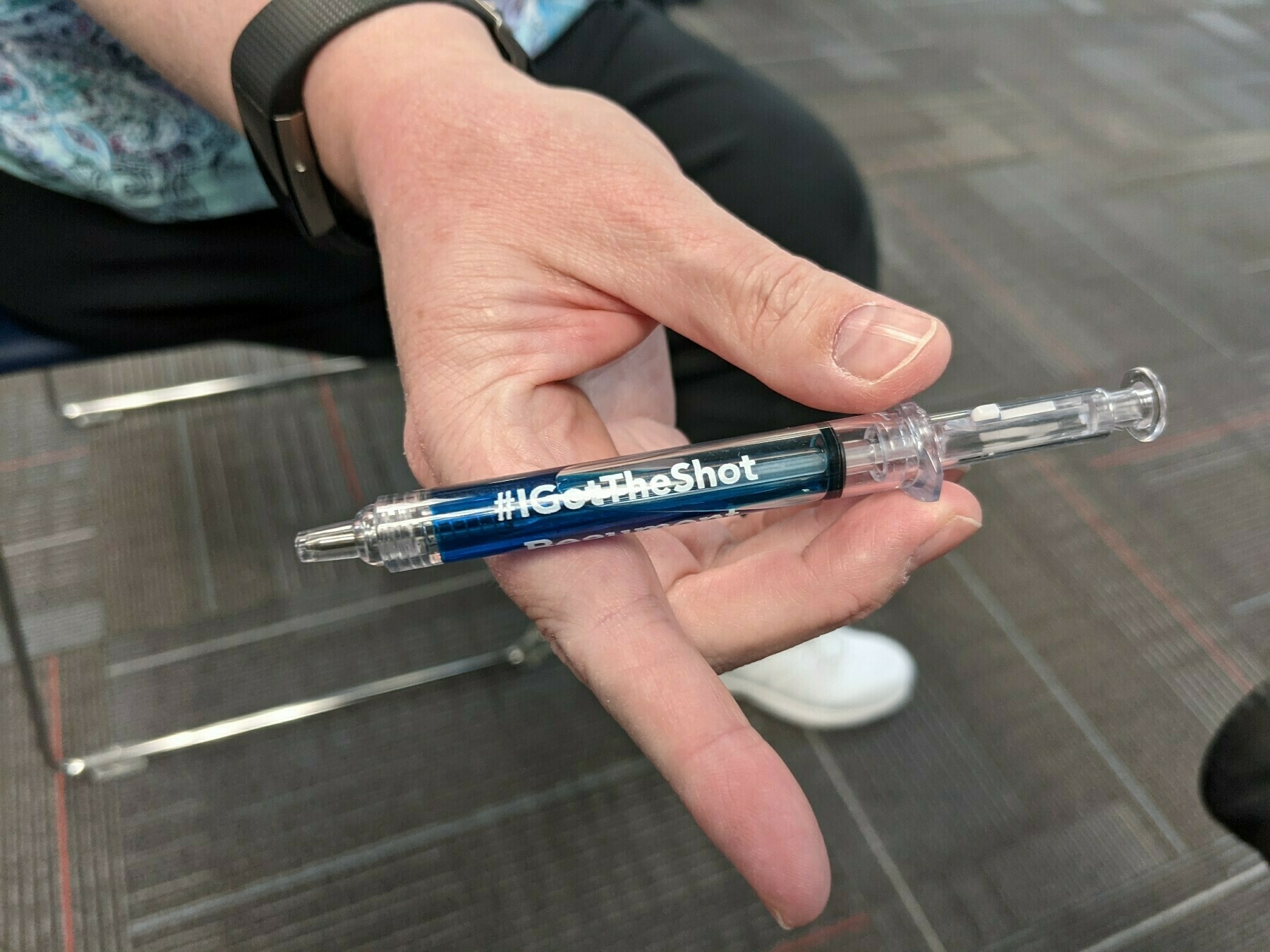
We took our shot!
I set up a new Google TV to replace the Chromecast that was connected to our living room TV. The change was driven by the increase in the number of streaming services/apps that we now use, and which previously was primarily accessed via the Apple TV attached to the TV in our basement. Google TV doesn’t look much different than Apple TV, and I imagine Roku isn’t much different either. The remote enables voice access to Google Assistant, which I use more than Siri. I did notice that the MLB At Bat app is not the same as the one on Apple TV, but Netflix, Disney+, ParamontPlus, and Amazon all look much the same. Google TV costs much less than Apple TV. Ironically, I set up the Apple TV app and it too looks pretty much the same. I have to chuckle about running Apple TV on a Google product.
According to my notes, on this date last year we learned of the first fatality in Michigan due to COVID-19. As I read my blog from last year I am reminded of how much was not known about COVID-19 and the fear and chaos that transpired. From that back story comes the fact that today I and my wife will be getting our first vaccine shots.
Scheduled my COVID-19 vaccination apointment!
Cancel culture is the logical conclusion of a society without the humility to recognize that changing one’s mind, which is part of growth, is a virtue. Cancel culture is amplified by defining justice as retribution rather than restoration.
All Praise Lou Ottens: The Inventor of the Cassette Tape Dies at Age 94
Ironically, just yesterday I was talking with my wife about cassette tapes after she turned on my twenty year old bookshelf stereo that resides in the room she was cleaning. Before the great basement flood I has all the cassette tapes of my high school and college years. Now of one found a cassette they would be hard pressed to know what to do with it.
9to5Google says there will be a spring Wear OS Platform update and they cite the Tiles feature added last year. When you swipe left on the watch face you will see some information. First you could only see your Fit “rings” show step and heart point progress, but they added up to five additional tiles. After the step and heart points, I see weekly heart point progress, timer options, the current weather forecast, and my heart rate.
I agree very much with this sentiment that Wear OS Watchmakers Seem Destined to Kill the Platform. My theory is that because Google is not doing much with Wear OS that the watch makers are holding back using the Qualcomm 4100 until the 2021 Christmas shopping season. If they don’t, they won’t have a compelling reason for people to buy watches then. The fact that Google bought Fitbit doesn’t help the matter. My next watch, if it is Wear OS, will have the Qualcomm 4100 and I will wait until one is available.
I have tested the new Nearby Share function between my Pixel 4a and a Lenovo Duet running Chrome OS 89 and it worked as described.
Map the System is a global competition that challenges you to think differently about social and environmental change.
A year ago today I noted the first reported cases of COVID-19 in Michigan.
Yesterday was the first day I qualified for the COVID-19 vaccine in Michigan. I didn’t spend much time, but every site I checked had no shots available and thus were not taking appointments. There is not yet enough supply to set up operations to administers thousands of shots a day. Thinking of drive-thru or stadium vaccination locations.
We knew all along that Trump would never acknowledge nor accept defeat, in fact he still hasn’t. And I don’t yet think we can claim democracy in the U.S. has been saved.
We are now at the one year mark of when COVID-19 started being real for most Americans. Little did we know then just how awful it would truly be, with hundreds of thousands dead. But even worse, is that there is a significant number of people who don’t seem to care that 500,000+ Americans have died.